Creating a Platform for Open Conversations
Russell Payne, a third-generation painter and decorator began The Talking Tradesman podcast after facing his own mental health struggles. Prior to this, he had little understanding of mental health. ‘If you’d have asked me, “Russell how’s your mental health” I would have answered that I haven’t got it.’
When Russell first experienced anxiety and panic attacks, it planted a seed and led him to learn more about the subject. ‘That opened a door for me to a world I had given no attention to throughout 30 years of my life.’
Motivated to educate himself, Russell went on to complete a degree in psychology, specialising in counselling and therapy. ‘I thought if I can educate myself here, then maybe I can help some people.’
Russell began volunteering with the Samaritans and working on crisis calls. It was here where he noticed a concerning pattern, ‘I had no idea it was that bad. The amount of people in the trades I was talking to was disproportionate to the number of calls we were getting.’ This experience further reinforced his decision to create a platform for open conversations.
The Talking Tradesman podcast provides a safe space for tradespeople to share their experiences and seek guidance, with each episode featuring a new guest. Russell shared that the response to the podcast completely shocked him. ‘I thought my biggest struggle would be getting people who are comfortable to be vulnerable on a public platform but it’s the opposite. Nearly everyone has approached me to tell their story.’
‘What I’ve tried to do is give a voice to the trades and the working-class people of the country.’
Turning Lived Experience into Change
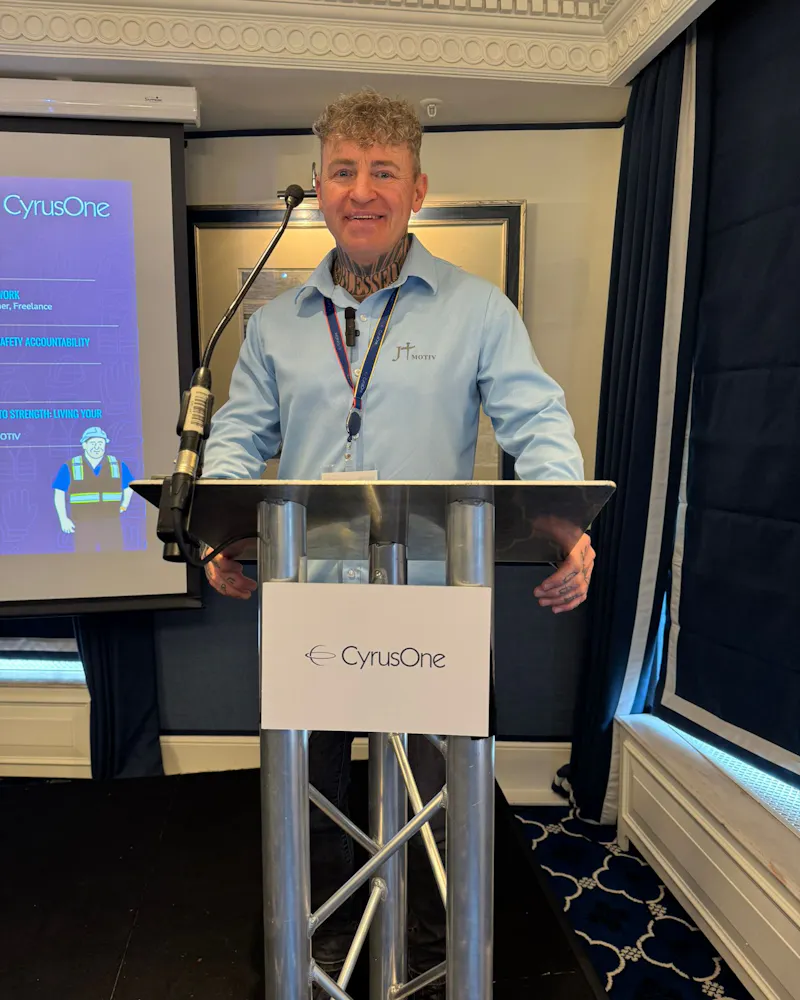
James Ford is the founder of JT Motiv, a mental health awareness platform, which also works to break down the stigma. JT Motiv began with motivational WhatsApp statuses in lockdown and led to a growing platform on YouTube and other social media channels. James uses his history of addiction and mental health struggles to share his story in construction sites and other workplaces.
‘In my first year of gambling I wanted to take my own life. It had gotten that bad. My talks take me all over the UK and Europe to share my story and help others.’
James shares his powerful story and encourages workers to get help if they need it. ‘I think people can relate to me. Lived experience is important. People want to feel heard, listened to, and seen.’
After his very first talk, James realised the impact these conversations could have. ‘It was phenomenal. After the talk, a guy in his 60s approached me and told me he was struggling. I said I was happy to help him and that night his wife messaged me and said he’d come home a different man.’
Changing the Culture
Both Russell and James agreed that greater awareness is being raised, but there’s still a lot more work to be done. James explained, ‘When you go on site there’s PPE; you have your hard hat, glasses, and boots, but what about your mind? It’s just as important. The “man up, get on with it, we’ve got deadlines to get” mentality is why there’s an issue in construction.’
Russell echoed these views, highlighting the importance of education, ‘We need to normalise these conversations from the top down. People don’t ask people if they’re okay because they don’t know what to do if somebody says no. That is terrifying.’
James also stressed the importance of responding correctly when someone opens up. ‘If someone comes over and says they’re struggling, the worst thing you can do is brush them off. That person will find it difficult to ask for help later down the line.’
It is evident that greater awareness and education are essential to break the stigma surrounding mental health in the trades. Russell and James’ stories are a reminder of the importance of open conversations in the industry. Their willingness to share their own experiences prove that strength in the trades isn’t just about the physical work but also looking after your mental health and supporting those around you.